
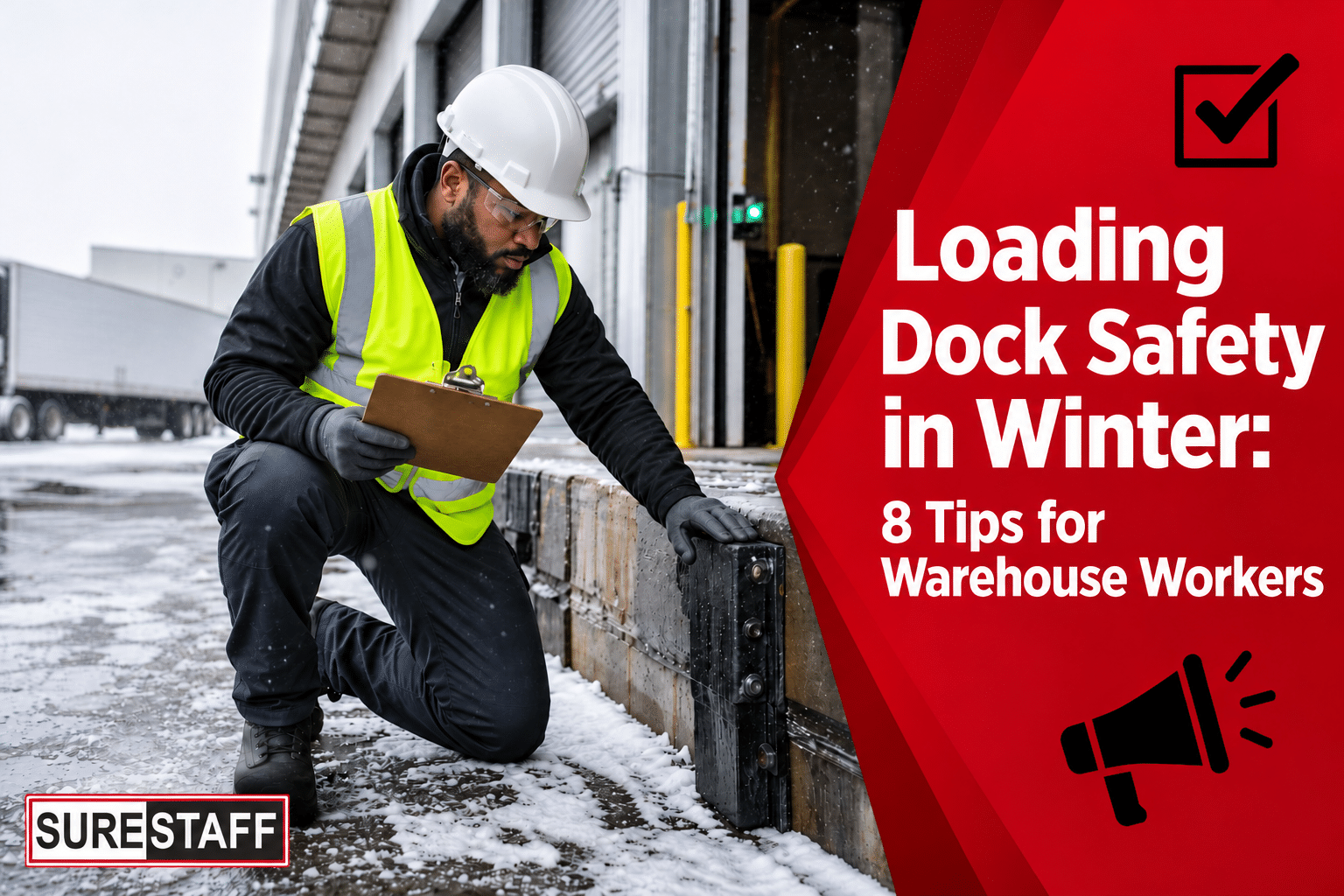
Loading Dock Safety in Winter: 8 Tips for Warehouse Workers
A trailer backs into door six coated in frost, the dock plate is slick from meltwater that refroze overnight, and the forklift operator has twelve pallets to move before the next truck arrives. Nothing about that scene is unusual in January, and every part of it carries risk. This guide covers winter loading dock safety for the people who work the dock every day, with notes on what supervisors and employers can do to back them up.
Why Loading Dock Safety in Winter Deserves Extra Attention
The dock is the one place in a warehouse where indoor and outdoor conditions collide. Doors stay open, cold air pours in, moisture tracks across the floor, and trucks and forklifts share tight quarters. In winter, each of those conditions gets harder to manage. Surfaces that stay dry in July become slick, equipment responds differently in the cold, and workers moving between heated and unheated zones lose dexterity and attention without realizing it.
In our experience, winter dock incidents rarely come from one dramatic failure. They come from small things stacking up: a patch of ice nobody salted, a pair of worn boots, a driver and a dock worker who never confirmed the trailer was secured. Safety here is a shared responsibility. Employers control the environment, the equipment, and the policies. Workers control their attention, their gear, and whether they speak up when something looks wrong.
The eight tips below follow that split. Each one is something you can act on during your next shift, and several include ways supervisors can make the safe choice the easy choice.
Keep Walking and Working Surfaces Under Control
Ice and snow are the most visible winter hazards, and they are also the most predictable. The areas that deserve the most attention are the apron outside the dock doors, the dock plates and ramps themselves, and the threshold where wet boots meet a smooth interior floor.
Workers can help by treating every transition as suspect. Slow down when stepping from a dock plate onto the floor, from the trailer onto the plate, and from outside onto concrete. Wet metal plates are especially slick, and a loaded pallet jack or hand truck can slide in ways that surprise even experienced operators. If you spot a wet or icy patch, report it and mark it. Do not assume someone else has already flagged it.
Supervisors and facility teams carry the heavier load here. Salt or ice melt needs to go down before shifts start and again as conditions change, and entry mats at the dock door help pull moisture off boots and wheels. Pooled meltwater near doors should be cleared before it refreezes. One honest limitation: de-icing products only go so far in extreme cold, and some can degrade concrete or track into the building as residue, so surface control works best as a routine of repeated checks rather than a single application.
Respect the Equipment in Cold, Wet Conditions
Dock equipment behaves differently in winter. Trailer restraints can freeze or collect ice, dock levelers can stiffen, and forklift tires lose grip on wet or frosty surfaces. Hydraulic components are slower to respond when the temperature drops, which can throw off the timing operators have built into their routine.
Before loading or unloading, confirm that the trailer is actually secured. Check the restraint, chock the wheels where your site requires it, and verify with the driver rather than assuming. A trailer that creeps away from the dock while a forklift is crossing the plate is one of the most serious events a warehouse can face, and slick pavement makes it more likely in winter.
Forklift operators should adjust their driving to the conditions. That means lower speeds, wider turns, longer stopping distances, and extra care on ramps and plates. Operators should also pre-check their equipment at the start of the shift, since cold can affect brakes, steering response, and lights. If a leveler or restraint is not working properly, tag it out and report it rather than working around it.
Dress for the Dock, Not the Weather Report
The dock is not one temperature. A worker might spend ten minutes in a heated aisle and the next ten at an open door in freezing wind. That swing is why layering beats a single heavy coat.
A practical approach is three layers: a moisture-wicking base, an insulating middle layer, and an outer layer that blocks wind and sheds light moisture. Layers can be removed as you warm up, which matters because sweating in cold air makes you colder once you stop moving. Cotton holds moisture and is a poor choice against the skin.
Footwear deserves special attention. Slip-resistant soles with real tread are the baseline, and insulation helps keep feet responsive. Gloves should protect against cold without costing you the grip needed to handle freight and equipment controls, so many workers keep a thinner pair for detail work and a heavier pair for time outdoors. Visibility gear matters too. Short winter days and fog mean hi-vis vests and reflective strips are doing real work on the dock, where drivers and operators need to see you early.
Watch for Cold Stress and Communicate Constantly
Cold affects judgment before it affects comfort. Early signs of cold stress include shivering, numb fingers, clumsiness, and slowed thinking. Because those symptoms look like normal winter fatigue, workers often push through them. A worker who is cold and distracted is more likely to misjudge a step, drop a load, or miss a signal.
Pacing helps. Warm-up breaks in a heated area give the body time to recover, and rotating tasks so no one spends an entire shift at an open door reduces exposure. Staying hydrated matters in winter too, since people tend to drink less when it is cold. If a coworker seems unusually slow, confused, or is shivering heavily, treat it as a safety issue and get them to a warm area.
Communication between the dock team and drivers is the other half of this. Agree on signals before a trailer is opened, confirm when a truck is secured and when it is cleared to leave, and keep conversations clear even when wind and engine noise make it harder. Sites with bilingual crews should make sure safety instructions are available in both English and Spanish, so no one is guessing at a warning. A crew that talks constantly catches problems that individual caution misses.
The 8 Winter Loading Dock Safety Tips
Here is the full list in one place, tying together the sections above:
- Treat every transition as slippery. Slow down at dock plates, ramps, and thresholds where wet and dry surfaces meet.
- Report ice and standing water immediately. Mark the hazard and tell a supervisor so it gets treated before it refreezes.
- Confirm the trailer is secured every time. Check the restraint, use wheel chocks where required, and verify with the driver before a forklift enters.
- Inspect equipment at the start of the shift. Cold can affect brakes, steering, lights, and hydraulics, so check them before loading begins.
- Adjust forklift driving to the conditions. Reduce speed, take wider turns, and leave extra stopping distance on wet or frosty surfaces.
- Layer clothing and choose the right footwear. Use a moisture-wicking base, an insulating layer, and a wind-blocking shell, plus slip-resistant, insulated boots.
- Take warm-up breaks and learn the signs of cold stress. Shivering, numbness, and clumsiness are warnings, not weakness. Hydrate and rotate away from exposed doors.
- Communicate clearly with drivers and teammates. Agree on signals, confirm every step of the load, and make sure instructions reach everyone on the crew.
These tips work best as habits rather than reminders. A trade-off worth naming: following them adds a little time to each load, and on a busy dock that can feel like friction. Skipping them tends to cost far more, in injuries, damaged freight, and lost shifts.
Build a Dock Where Safe Work Is Normal Work
Winter dock safety is not about one heroic worker or one new policy. It is about a workplace where gear is provided, hazards get fixed quickly, breaks are respected, and people feel comfortable calling out what they see. Hiring teams who struggle with coverage on cold-weather shifts often find that safety culture and reliability go hand in hand, a connection explored in the hidden cost of light industrial staffing failures.
If you are a warehouse job seeker, a workplace that takes dock safety seriously is a good sign about how it treats its people overall. When you are comparing opportunities, it helps to know how to get hired faster for warehouse jobs and what employers look for. If you manage a dock and need dependable, safety-minded people on every shift, SURESTAFF can help you connect with them, and our team can help you find the workplace or the workers that fit.